No Safe Harbor: Why No Navy on Earth Can Reliably Defend Against Autonomous Underwater Attack
I am not a naval defense expert. My background is in security architecture and critical infrastructure protection. But when an autonomous underwater drone destroyed a submarine inside a defended harbor in December 2025, I found myself asking a question I couldn’t let go of: could we actually protect our own ports — in Europe, in NATO — against this kind of attack? The answers I found in publicly available sources surprised me enough to write them down.
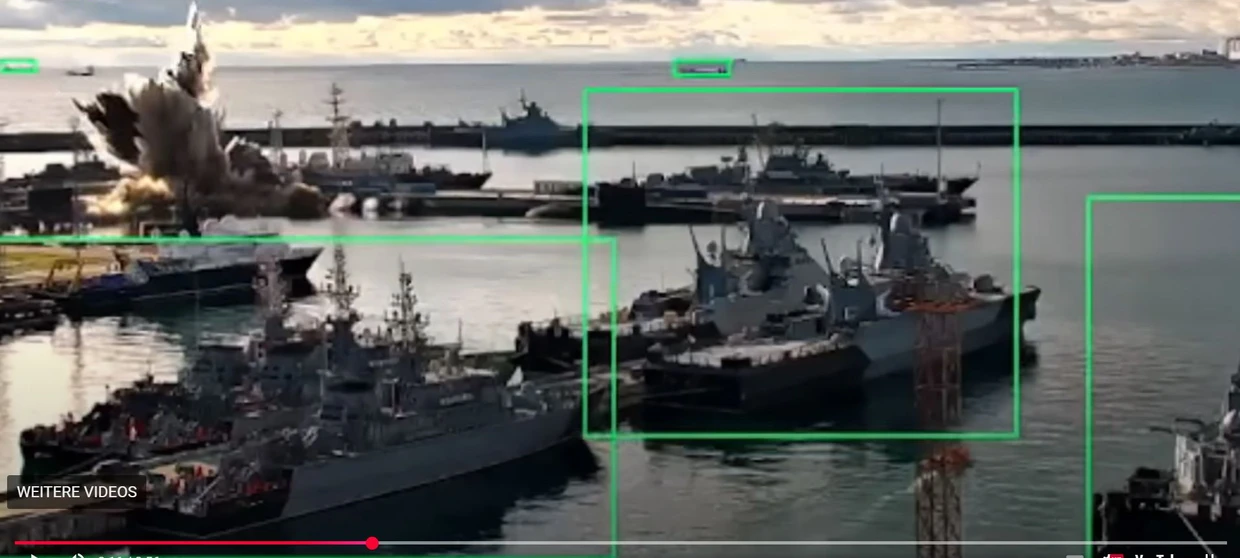
On the night of December 14–15, 2025, a Ukrainian autonomous underwater vehicle — roughly six meters long, battery-powered, and carrying a substantial explosive payload — reached the perimeter of the Russian naval base at Novorossiysk. It navigated approximately 500 to 600 nautical miles from its likely launch point near Odessa, crossed the Black Sea without any publicly confirmed detection, and struck a Project 636.3 Improved Kilo-class submarine — a Kalibr cruise missile carrier — moored at the pier. According to Ukraine’s Security Service and corroborated by UK Defence Intelligence, the submarine suffered critical damage and has not moved since. Within days, satellite imagery showed Russia scrambling to erect underwater nets, sink blockships, and deploy barriers across its Black Sea harbors — measures last seen at this scale during the Second World War.
The attack itself was remarkable. But what matters for every other navy in the world is the question it forced into the open: Could we stop this?
The honest answer, based on what is publicly known across a dozen countries and several dozen defense programs, is: not reliably — not today, and likely not in the near term.
This article examines why.
The Problem: A New Operational Category With No Established Counter
To understand why the Novorossiysk attack is different from previous maritime drone incidents — the attacks on the Kerch Bridge, the harassment of Russian ships by surface drones, even the USS Cole bombing — you need to understand what made the weapon different.
The Ukrainian system, widely known as „Sub Sea Baby“ (a name attributed to its developers at the Bratstvo design bureau), is not a remote-controlled torpedo. It is not a fast surface drone packed with explosives. It represents a new operational category: a large, slow, autonomous underwater vehicle designed for long-range one-way attack.
The key parameters that define the threat are straightforward. At roughly six meters in length and an estimated displacement of several hundred kilograms, it is far larger than recreational or research AUVs but far smaller than a manned submarine. Its battery-electric propulsion makes it acoustically very quiet — orders of magnitude quieter than even the stealthiest diesel-electric submarine running on its engines. Its cruise speed of an estimated 3 to 5 knots makes it slower than virtually any naval vessel, but this slowness is a feature, not a bug: it maximizes range (the cubic relationship between speed and energy consumption in water is unforgiving) and minimizes acoustic signature. And its navigation is fully autonomous — inertial navigation system, likely supplemented by terrain-matching sonar and intermittent GPS fixes when surfacing. No command link to jam.
This combination creates a detection problem that no existing naval defense system was designed to solve. Traditional anti-submarine warfare is optimized for finding large, relatively fast submarines in deep water — sonar systems tuned for the acoustic signatures of nuclear or diesel-electric boats, magnetic anomaly detectors designed for thousand-ton ferromagnetic hulls, patrol aircraft covering vast ocean areas. Harbor defense, meanwhile, has historically focused on two threats: combat divers (slow, small, but generating telltale breathing noise and bubble trails) and mines (static objects to be found and swept).
An autonomous combat UUV fits neither category. It is too small and quiet for conventional ASW. It is too fast and purposeful for mine countermeasures. It does not breathe. It does not communicate. It simply arrives.
The Global Landscape: Everyone Is Looking, Nobody Has Found
A survey of counter-UUV efforts across the major naval powers reveals a consistent pattern: the problem is recognized, programs have been initiated, but no country possesses an operational, integrated system that can reliably detect, classify, and neutralize an autonomous combat UUV approaching a harbor.
United States: Best Problem Definition, No Operational Hardware
The United States has the clearest articulation of the counter-UUV problem, expressed through two parallel tracks.
The first is a pair of Small Business Innovation Research (SBIR) solicitations released by the Naval Sea Systems Command in April 2025. One seeks technology for the „Delay and Denial of UUVs,“ with a stated requirement to neutralize a UUV within 100 to 200 meters of a defended asset. The other targets „Interception of Unmanned Underwater Vehicles,“ seeking systems that can intercept small and medium UUVs at sprint speeds down to 800 feet depth. Both solicitations contain a critical admission: permanent underwater barriers are not a viable option because they interfere with normal port operations. The Navy wants something that can stop a UUV without stopping its own ships.
The second track is more ambitious and more secretive. In September 2024, the Defense Advanced Research Projects Agency (DARPA) released a classified solicitation for a program called „Sync.“ The program description, in the limited unclassified portions, states that Sync seeks „orthogonal approaches to counter UUVs that do not rely on the complex detection and localization of the UUV.“ This is a remarkable admission. DARPA — the agency that develops technology at the edge of what is possible — is essentially saying that the conventional detect-track-engage paradigm may not work against this threat, and that entirely new concepts are needed.
The only physically tested counter-UUV system in the United States appears to be the Stingray, developed by Oceanetics (also known as Maritime Arresting Technologies) in Annapolis, Maryland. Stingray is a rapidly deployable net that spans from the surface to the seabed, approximately 200 feet in length. In US Navy testing it achieved a 100 percent catch rate. The material is monofilament nylon — essentially, a very large fishing net. It works. But it also blocks everything else, which is exactly the limitation the Navy’s own SBIR solicitations identify.
On the offensive side, the Defense Innovation Unit (DIU) released a solicitation in July 2025 seeking „one-way attack“ kamikaze UUVs and submarine-launched hunter-killer systems. The Pentagon’s interest in building its own autonomous underwater weapons only underscores how seriously it takes the threat — and, by implication, how poorly prepared it is to defend against them.
Open-source anchors: NAVSEA SBIR solicitations (Apr 2025); DARPA Sync notice DARPA-PS-24-23 (Sep 2024); DIU CSO solicitation (Jul 2025); Oceanetics Stingray USN test reports.
United Kingdom: The Most Ambitious Architecture, For the Wrong Problem
In December 2025 — one week before the Novorossiysk attack — the UK Ministry of Defence announced „Atlantic Bastion,“ described as a revolutionary underwater surveillance system stretching from the Mid-Atlantic Ridge to the Norwegian Sea.
The technology base is impressive. BAE Systems‘ Herne, the UK’s first military extra-large autonomous underwater vehicle, offers multi-week endurance with modular payload bays. Helsing’s SG-1 Fathom is an underwater glider with a three-month patrol capability, powered by Lura AI for acoustic analysis, and slated for mass production in Plymouth. Anduril contributes a UK-developed variant of its Seabed Sentry system. Integration partners include Sonardyne, QinetiQ, Atlas Elektronik UK, and Northrop Grumman. All assets feed into a „Digital Targeting Web“ — a contact detected by a glider can be handed off to a Type 26 frigate or an Astute-class submarine. Some £14 million in MOD investment has been matched by approximately £56 million in private sector funding, with first operational elements expected in 2027.
The limitation is fundamental: Atlantic Bastion is designed for open-ocean anti-submarine warfare, primarily to monitor the GIUK Gap and protect undersea infrastructure against Russian submarines. It is a deep-water surveillance architecture, not a harbor defense system. The sensor types, engagement ranges, and operational concepts are optimized for detecting Yasen-M class nuclear submarines in the North Atlantic — not six-meter battery-powered drones creeping into Portsmouth at three knots.
Open-source anchors: UK MOD Atlantic Bastion announcement (Dec 2025); BAE Systems Herne program; Helsing SG-1 Fathom specifications.
France: World-Class Mine Hunting, No Counter-UUV Capability
France, in partnership with the UK, operates the most advanced autonomous mine countermeasures system in the world. The SLAM-F/MMCM program, led by Thales, delivered the world’s first autonomous MCM drone system in December 2024. Exail A18-M AUVs equipped with Thales SAMDIS-600 synthetic aperture sonar can find and classify mines with impressive precision.
But mines sit still. The entire French system — sensors, processing, engagement doctrine — is optimized for finding static objects on the seabed. Adapting it to detect and track a moving, autonomous vehicle is a fundamentally different challenge. France has no dedicated counter-UUV program.
Germany: World-Class Components, No System
Germany presents perhaps the most frustrating case: nearly all the building blocks exist, but nobody has assembled them.
Atlas Elektronik, based in Bremen with over 120 years of sonar experience, has the Cerberus Mod2 portable diver detection sonar — operationally proven, in service with eight navies including Ukraine, and installed on Germany’s own F125 frigates. Its ACTAS towed array sonar can detect submarines, torpedoes, UUVs, and mines. And Atlas produces the SeaSpider, the world’s only dedicated anti-torpedo torpedo — an active-homing underwater interceptor that autonomously seeks and destroys incoming torpedoes regardless of their guidance mode.
SeaSpider is the most intriguing potential counter-UUV effector that nobody is talking about. It was designed to kill 50-knot torpedoes — intercepting a 5-knot UUV should be vastly easier from a kinematics standpoint. The challenge would be adapting its seeker to acquire a target with a very different acoustic and physical signature. But the core technology — autonomous underwater homing, sprint speed, warhead — is proven.
Separately, Rheinmetall has partnered with Euroatlas to integrate the GREYSHARK AUV into Rheinmetall’s Battlesuite AI-enabled command-and-control platform. GREYSHARK is a capable mid-to-large AUV with 17 sensors and, in its fuel-cell variant, endurance of up to 16 weeks. Meanwhile, Rheinmetall Canada has already integrated Sonardyne’s Sentinel intruder detection sonar into its C2 system for harbor protection clients — a small but significant step.
The gap is integration. There is no German program to combine Cerberus detection, SeaSpider interception, GREYSHARK patrol, and Battlesuite command into a coherent harbor defense system. Each component lives in its own corporate silo, funded by its own budget line, marketed to its own customer base.
Open-source anchors: Atlas Elektronik Cerberus/SeaSpider product data; Rheinmetall-Euroatlas GREYSHARK partnership (Aug 2025); Rheinmetall Canada / Sonardyne Sentinel integration announcement.
Japan and South Korea: ISR Focus, Not Counter-UUV
Japan’s SHIELD concept (Synchronized, Hybrid, Integrated, Enhanced coastal Defense) envisions multi-layered drone networks for coastal surveillance, and the Japan Maritime Self-Defense Force inducted a domestically developed small UUV in January 2026. But the focus is intelligence gathering and open-water ASW, not harbor counter-UUV.
South Korea has a strong underwater sensor base driven by the real-world threat of North Korean mini-submarine infiltration. LIG Nex1 is developing NAIMS-II, a networked undersea surveillance system comparable to the Cold War-era SOSUS, with a budget of $482 million and planned operational date in the early 2030s. Hanwha is developing an anti-submarine warfare UUV — but it is a hunter-killer designed for full-size submarines, not small autonomous drones.
Israel: The Closest Thing to an Integrated Solution
DSIT Solutions, an Israeli defense firm now linked with Rafael Advanced Defense Systems, operates what is likely the most mature harbor sonar architecture in existence: SeaShield for long-range detection (50+ km), AquaShield for medium range, and PortView/SiteView for integrated command and control, fusing above-water and underwater sensor data.
DSIT’s systems are optimized for exactly the harbor environment that confounds open-ocean sonar — shallow water, heavy acoustic clutter, high commercial traffic. What DSIT lacks is a validated effector. Rafael’s Torbuster system is an anti-torpedo hard-kill solution, but it is designed for fast, small torpedoes, not slow, large UUVs. Whether a derivative could be adapted is an open question.
Russia: The Lesson of Reactive Defense
Russia’s response to the Novorossiysk attack is itself instructive. Satellite imagery from mid-December 2025 onward shows a massive expansion of physical barriers at Black Sea ports: underwater nets and booms (modernized versions of World War II anti-submarine nets, now with integrated sensors), sunken ships and concrete barriers at harbor entrances, and expanded hydrophone arrays.
The operational cost has been severe. Russia’s Black Sea Fleet is now effectively trapped behind its own defenses — the barriers that keep Ukrainian drones out also prevent Russian ships from moving freely. Combat swimmer teams provide a low-tech but manpower-intensive additional layer. Electronic warfare, particularly GPS jamming, has been deployed to degrade UUV navigation accuracy, but fully autonomous systems using inertial navigation are inherently resistant to jamming.
The Russian approach confirms the central finding: no integrated, purpose-built solution exists. Everything is a reactive patchwork.
The Detection Challenge: Why Finding a UUV Is So Hard
The core technical challenge deserves closer examination, because it explains why even sophisticated navies are struggling.
A conventional submarine, even a very quiet one, produces a complex acoustic signature: machinery noise, flow noise, propeller cavitation, and the occasional transient (a dropped tool, a closing valve). Passive sonar systems, refined over decades of Cold War competition, can detect these signatures at impressive ranges.
A battery-powered UUV at low speed produces almost none of this. Its electric motor generates minimal vibration. At 3 to 5 knots, there is negligible flow noise and no cavitation. The dominant sound may be nothing more than the faint hum of electronics — a signal that is easily lost in the ambient noise of a busy harbor: ship traffic, wave action, biological noise, industrial rumble from port infrastructure.
Active sonar can, in principle, detect the physical hull. But in a harbor environment, active sonar faces crippling challenges: reverberation from the shallow seabed and surface, acoustic clutter from pier structures and moored vessels, and the extremely small target cross-section of a six-meter plastic-and-metal vehicle compared to a 70-meter submarine.
Diver detection sonars like Sonardyne’s Sentinel — the most widely deployed system of its type, in service globally since 2007 — can detect UUVs at ranges of 1,200 to 1,500 meters using a patented technology called SInAPS (Simultaneous In-band Active and Passive Sonar). This is genuinely useful, but 1,200 meters of warning at 3 knots gives you roughly 13 minutes of reaction time. Is that enough to activate a countermeasure? It depends entirely on what countermeasure you have — and who is authorized to use it.
A potentially game-changing approach is emerging from Chinese academic research, published in the journal Applied Acoustics in mid-2025: the forward-scatter acoustic barrier. Instead of bouncing sound off a target and listening for echoes (which are weak), you place transmitter and receiver buoys at a harbor entrance and establish a continuous acoustic field between them. When a UUV crosses the baseline, it disturbs the field — and that disturbance, according to Babinet’s principle, produces a signal roughly 15 dB stronger than a conventional backscatter echo. The system was validated in sea trials with source-receiver separations of approximately 550 meters in 8 to 10 meters of water depth. Every AUV crossing event was clearly detected.
This is not yet an operational system. But it represents a fundamentally different detection philosophy — a tripwire rather than a searchlight — and it could be a crucial building block.
Non-acoustic sensors offer supplementary detection paths but face their own limitations. Magnetic anomaly detection can identify the ferromagnetic content of a UUV hull, but the magnetic field falls off with the cube of distance, making detection ranges very short (meters to tens of meters). Magnetometry is useful for close-range classification — confirming that a sonar contact is metallic rather than biological — but not for initial detection. Underwater LiDAR and optical systems can provide visual identification in clear water, but harbor waters are rarely clear.
Open-source anchors: Sonardyne Sentinel / SInAPS specifications; Wavefront Systems ANTX trial results; „Harbor protection with underwater acoustic barrier,“ Applied Acoustics (May 2025).
The Decision Problem: What Happens at 62% Confidence?
Even if detection is solved technically, a harder problem follows: the authorization to act.
Consider the scenario. It is 3 AM at a major naval base. The system flags a contact at the harbor approach. Acoustic classification returns 62% probability of combat UUV, 23% probability of large marine animal, 15% probability of civilian survey AUV. The contact is moving at 4 knots on a course toward the submarine pens.
What do you do?
If you activate the hard-kill option — launch an interceptor torpedo or close the barrier — and the contact turns out to be a €200,000 civilian research AUV from a university conducting an authorized seabed survey, you have destroyed private property, potentially killed the research program’s funding, and created an international incident. If the contact is a harbor seal, you have wasted an expensive weapon and, depending on jurisdiction, violated environmental protection law. If you do nothing and it is a Sub Sea Baby carrying 200 kilograms of explosive, you lose a submarine and its crew.
This is not a hypothetical edge case. It is the normal operating condition. Harbor environments are filled with acoustic clutter, marine life, recreational divers, commercial AUVs conducting infrastructure inspections, and debris. Any system sensitive enough to detect a combat UUV will generate contacts that are ambiguous.
In practice, a credible system would require a live „white list“ of authorized underwater activity in the defended area — and secure, standardized notification procedures for civilian operators, research institutions, and port contractors. Most ports do not currently have anything of the kind.
The doctrine will likely need to evolve toward an escalation ladder: classify, warn, disrupt, delay, and only then hard-kill. Soft-kill options — acoustic deterrents, bubble curtains that degrade navigation, net barriers that entangle without destroying — would serve as intermediate steps that buy time and reduce the cost of false positives. But building that escalation ladder is as hard as building the sensor.
Who authorizes a hard kill in a harbor? At what confidence threshold? Under what rules of engagement? Is there a human in the loop for every engagement, or is the system authorized to act autonomously at a certain threat level? What liability framework covers a false positive that destroys civilian property — or a false negative that destroys a warship?
Few programs publicly address these questions. In many European ports, decision authority is split between navy, port authority, environmental regulators, and law enforcement — exactly where minutes matter. The SBIR solicitations ask for technology. DARPA asks for concepts. The decision-authority problem — the intersection of technology, law, and operational doctrine — remains largely unexamined. Any system that solves the detection and engagement problems but ignores the decision problem is incomplete — and potentially dangerous.
The Engagement Challenge: How Do You Neutralize What You’ve Found?
Assuming a contact has been detected and a decision to act has been authorized, the engagement problem remains. How do you neutralize an autonomous UUV without disrupting port operations, damaging infrastructure, or creating a worse problem than the one you are solving?
The options fall into three broad categories.
Physical barriers are the simplest and most proven approach. Oceanetics‘ Stingray net works. HALO Arabia offers modernized barrier systems with fiber-optic sensor nets woven into physical barriers — each panel is a detection zone, with coded infrared light through the fiber triggering an alarm on any break. HALO claims 99.99% detection probability with near-zero false alarm rate and a 30-year lifespan. For permanent high-value installations, this may be the most practical near-term solution. The limitation is operational: a net that blocks a UUV also blocks your own traffic. Retractable gate systems exist (HALO’s GUARDIAN has been independently tested by the US military), but „open gate equals vulnerability window“ is an inherent tradeoff.
Interceptor vehicles — dedicated counter-UUV drones that hunt and neutralize threats — are the most conceptually appealing solution but the least mature. The US Navy’s SBIR solicitations describe exactly this capability, but no system has been demonstrated. The physics are challenging: underwater, interceptors are slower to maneuver than their airborne equivalents, energy is scarce, and the acoustic environment makes terminal guidance difficult.
The most promising building blocks come from an unexpected direction. Leonardo’s Black Scorpion mini-torpedo — 1.1 meters long, 127 mm diameter, 15+ knots, active sonar homing, 2.8 kg PBX warhead — was designed to force submarine contacts to reveal themselves, but it is explicitly marketed for use against UUVs, midget submarines, and swimmer delivery vehicles. It can be launched from aircraft, surface vessels, and — most significantly — from underwater platforms. In late 2024, Italian firm Drass demonstrated the successful launch of Black Scorpion from its DS-8 swimmer delivery vehicle during sea trials at the Italian Navy’s test facility in La Spezia. Drass also produces the Ronda LUUV, an unmanned variant approximately 20 meters long. An armed Ronda carrying Black Scorpion torpedoes is, conceptually, exactly the autonomous counter-UUV hunter-killer that does not yet officially exist.
Atlas Elektronik’s SeaSpider anti-torpedo torpedo is another potential pathway. SeaSpider is proven — it autonomously detects, tracks, and destroys incoming torpedoes in a high-clutter underwater environment. The kinematics of intercepting a 5-knot UUV are far more forgiving than intercepting a 50-knot torpedo. The question is whether the seeker can be adapted for a fundamentally different target signature.
Non-kinetic disruption is the least explored but potentially most creative category — and, crucially, the most compatible with the escalation ladder described above. Bubble curtains — curtains of compressed air rising from seafloor-mounted hoses — are well-established technology for underwater noise mitigation during construction. But a dense bubble curtain also creates massive acoustic impedance mismatches that could blind a UUV’s sonar and navigation sensors, generates turbulence that could destabilize a small vehicle’s attitude, and disrupts any acoustic communication link. Unlike a physical net, a bubble curtain can be activated and deactivated in seconds, does not block ship traffic, and is environmentally benign. Whether it could actually stop or sufficiently degrade a well-designed UUV is unproven, but the concept maps closely to the „orthogonal approaches“ DARPA’s Sync program is seeking.
Open-source anchors: HALO Arabia barrier systems / MarineNet fiber-optic specifications; Leonardo Black Scorpion data sheet; Drass DS-8 / Black Scorpion sea trials (Naval News, Dec 2024); Atlas Elektronik SeaSpider program data.
What an Ideal Defense Would Look Like
Based on the analysis above, an effective harbor counter-UUV system would likely require four integrated layers.
Layer 1: Wide-area persistent surveillance (5–50 km). A distributed network of passive hydrophones, mobile acoustic sensors on underwater gliders or autonomous surface vehicles, and fixed seabed arrays. The goal is not to stop anything at this range, but to detect anomalous contacts early enough to provide reaction time. Existing building blocks include DSIT’s SeaShield, underwater gliders like Helsing’s SG-1 Fathom, and patrol USVs like Ocean Power Technologies‘ WAM-V with underwater sensor packages.
Layer 2: Harbor approach detection and classification (≈0.5–5 km, depending on bathymetry and clutter). High-resolution active sonar, forward-scatter acoustic barriers at harbor entrances, and patrol AUVs with multi-sensor suites (sonar, magnetometer, optical) for close-range classification of contacts. The key technology gap here is AI classification — no existing system is trained to reliably distinguish an autonomous combat UUV from marine debris, large fish, or civilian AUVs. Existing building blocks include Sonardyne’s Sentinel 2 with SInAPS, Atlas Elektronik’s Cerberus, and the Chinese forward-scatter acoustic barrier concept.
Layer 3: Decision and engagement zone (0–500 m). A combination of escalating responses: classification confirmation by patrol AUV, acoustic warning and disruption (bubble curtains, non-kinetic deterrents), rapidly activatable physical barriers (retractable nets with fiber-optic detection), and — as last resort — interceptor UUVs armed with mini-torpedoes (Black Scorpion or equivalent). The critical requirement: these systems must be able to neutralize a threat without permanently blocking port operations. Existing building blocks include HALO’s retractable barriers, Leonardo’s Black Scorpion, Oceanetics‘ Stingray, and Atlas Elektronik’s SeaSpider (if adapted).
Layer 4: Integrated command, control, and authorization. A single operator console fusing all sensor data into a unified track picture, with AI-assisted classification, threat assessment, and engagement recommendations — mapped against the authorized-activity white list and current rules of engagement. The operator sees: „Contact X, detected at Layer 1 forty minutes ago, confirmed at Layer 2 twelve minutes ago, classified as probable combat UUV with 91% confidence, not matching any authorized activity, current course toward berth 7, expected at harbor entrance in 23 minutes. Recommended action: activate barrier, deploy interceptor. Authorization required: commanding officer.“ Existing building blocks include DSIT’s PortView, Rheinmetall’s Battlesuite, and various military C2 frameworks.
The estimated cost for a complete four-layer harbor defense at a medium-sized naval base would be in the range of €50–150 million, depending on configuration. That sounds like a lot until you consider that a single modern submarine costs €400 million or more, and a single autonomous UUV costs perhaps €100,000 to €1 million. The cost asymmetry overwhelmingly favors the attacker. This is the same structural logic that defines IEDs versus armored vehicles, loitering munitions versus air defense batteries, and consumer drones versus billion-dollar radar systems: the cheap, disposable weapon forces the defender into disproportionate spending. Without harbor defense, every ship at anchor is a target whose replacement cost exceeds the cost of the attack by two to three orders of magnitude.
Who Could Build It?
No single company currently offers an integrated counter-UUV system. The question is who could assemble one fastest.
A European consortium of Leonardo (effector: Black Scorpion), Sonardyne/Wavefront (detection: Sentinel), and a C2 integrator like Rheinmetall or BAE Systems would have the strongest combined technical base. NATO-compatible, exportable, and covering detection, engagement, and command. The weakness is speed — European defense consortia are politically complex and slow to execute.
DSIT/Rafael from Israel has the most mature harbor sonar architecture and an integration culture built on speed. Israel’s defense industry excels at „good enough, fast“ — the Iron Dome philosophy. The gap is a validated effector, and export restrictions would limit the addressable market to perhaps half of potential customers.
Atlas Elektronik + Rheinmetall have world-class sonar, a potential effector in SeaSpider, a patrol AUV in GREYSHARK, and an existing C2 platform. All German and European, all exportable. The gap is institutional: German defense industry timelines are measured in decades, not years.
Anduril from the US has the development speed, the AI platform (Lattice), and the ambition. But ITAR export restrictions would largely limit sales to Five Eyes nations, and their focus is on open-ocean offensive systems rather than harbor defense.
The first entity to deliver a working integrated system — even an imperfect one — will define the market. Everyone else becomes a subcontractor.
But building it is only half the problem. Deploying it in a regulated European port environment — where environmental impact assessments, noise regulations, civilian traffic management, maritime law, and cross-border procurement rules apply — is an entirely separate challenge. The navy that wants to protect Wilhelmshaven or Toulon cannot simply bolt an Israeli sonar onto a German pier and call it done. Integration into regulated critical infrastructure requires qualification, certification, and legal frameworks that do not yet exist for this category of system. The company that understands this — that can navigate not just the physics but the bureaucracy — may matter more than the company with the best sensor.
Why This Matters Now
The Novorossiysk attack was not a one-off. Ukraine has demonstrated a capability that any state or non-state actor with moderate technical resources can replicate. The Sub Sea Baby is not built with exotic technology — it uses commercially available batteries, electric motors, inertial navigation units, and standard sonar components. Its sophistication lies in systems integration and operational concept, not in any single breakthrough.
The proliferation risk is real and immediate. Several state and non-state actors have demonstrated both intent and operational creativity with maritime drones in the surface domain. The step from surface drones (already widespread) to underwater autonomous systems is significant but not insurmountable. China has multiple XLUUV programs in development. Every major naval power is investing in offensive UUVs while simultaneously realizing it has no defense against them.
Every navy in the world now faces the same question: what happens when someone does this to us? The answer, as of February 2026, is that there is nothing reliable to stop it.
The technology to build a defense exists — in fragments, across multiple countries, in programs that do not talk to each other. The physics are understood. The building blocks have been tested. What is missing is integration, urgency, and the recognition that this is not a future problem. It is a current one.
The first navy that learns this lesson the hard way will not have the luxury of calling it a surprise.
This analysis is based entirely on open-source information including government solicitations, company publications, academic research, defense media reporting, and satellite imagery analysis. The author has no affiliation with any defense company or government agency mentioned in this article.
Weitere beliebte Beiträge
KI-Coding-Hype: Was tatsächlich messbar ist

Confident Wrong: Wenn KI unter Druck die Frage vergisst – und warum das im Security-Kontext kein Denkfehler ist, sondern ein Angriffsvektor
„Ein Produkt mit digitalen Elementen“ – was der Cyber Resilience Act für israelische Hardware-Hersteller bedeutet, die 2027 nicht vorbereitet sein werden

SOC Detection Observability: Warum Security Operations Center ihre eigene Erkennungsinfrastruktur nicht überwachen – und was NIS-2 daraus macht